
Wearing Every Hat - What Multi-Role Leadership Actually Looks Like in Tech
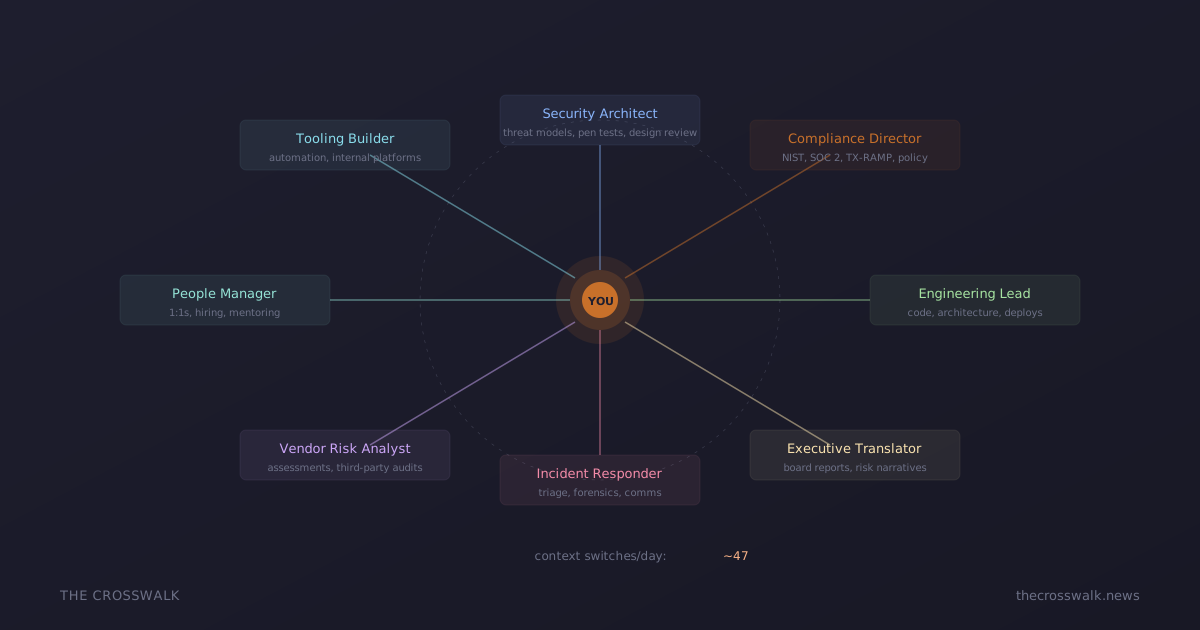
My job title says one thing. My calendar says about seven others.
On any given week, I'm writing security policies, reviewing compliance evidence, assessing vendor risk, advising on architecture decisions, translating audit findings for executives, and building tooling to make all of the above less painful. I'm the security person, the compliance person, the policy author, the risk analyst, and — when the situation calls for it — the one writing code to solve problems nobody else has bandwidth for.
This isn't a humble brag. It's the reality of working at a company that needs someone to connect dots across domains most organizations staff with separate teams. And here's the thing: this isn't unique to security leadership. If you've ever been the helpdesk tech who also manages the asset inventory, writes the onboarding docs, trains new hires, and fields calls from the CFO about why their laptop is slow — you already know exactly what I'm talking about.
The scale changes, but the feeling never does.
I want to talk about what this actually looks like — the good, the bad, and the parts nobody warns you about — whether you're wearing two hats or twelve.
The Superpower Nobody Puts on a Resume
The single biggest advantage of spanning multiple domains isn't breadth of knowledge. It's pattern recognition across boundaries and being able to connect dots yourself that would otherwise require teams collaborating.
Here's what I mean: Early in your career, you might be on the helpdesk and notice that every password reset request spikes on Monday mornings. That's a pattern. But if you also handle onboarding, you realize the spike happens because nobody's teaching new employees how to use the password manager during their first week. And if you also write the training docs, you can actually fix the root cause instead of just resetting passwords faster.
That's the same skill at a different altitude. At my level, it looks like this: when you own security and compliance, you see how a well-intentioned compliance control can create a false sense of security — because you're the same person who has to defend the actual attack surface. When you write policies and build the systems those policies govern, you develop an allergy to requirements that sound good on paper but collapse in production. When you sit in executive meetings and troubleshoot technical implementations, you develop a kind of fluency in translation that specialists rarely build.
That translation skill is the real superpower. Most organizations struggle not because they lack expertise in any single area, but because their experts can't communicate across domains. Security speaks in CVEs and threat models. Legal speaks in liability. Engineering speaks in systems and trade-offs. Leadership speaks in risk appetite and business impact. The helpdesk speaks in "what users actually do," which — if anyone bothered to listen — would save everyone else six months of bad assumptions.
Somebody has to sit between those conversations and make sure they connect. In a lot of companies, that somebody is a person like you or me — not because the job description says so, but because nobody else can see the full picture.
And that gives you something specialists often lack: the ability to see how a decision ripples. A change to your authentication flow isn't just a technical decision. It's a compliance evidence question, a user experience question, a policy update, a training revision, and a potential audit finding all at once. When one person holds all those threads, decisions happen faster and with fewer blind spots.
But there's a price, and it's very real.
The Cost Nobody Talks About
The conventional wisdom says depth is the first casualty. When you're responsible for six domains, you supposedly can't go as deep in any of them as someone who spends forty hours a week in one. And for some people, that's a real trade-off. If you're early in your career, you might feel it as knowing enough about networking to troubleshoot DNS but not enough to redesign the VLAN architecture — and wondering if that gap makes you a fraud.
But here's something that doesn't get talked about enough: not everyone experiences the multi-hat problem as a depth problem. The conventional framing assumes that covering more ground means covering it thinly. For some of us, that's just not how it works. Learning is the part that comes naturally — it's what we'd be doing anyway, whether the job demanded it or not. The depth accumulates because we can't help but dig in. And when that's your wiring, the cost of wearing many hats isn't shallow knowledge. It's the sheer energy of maintaining that depth across six or more domains simultaneously. That's the part that wears you down.
And that creates a different kind of problem. When you actually do have deep knowledge across six domains, the world doesn't quite know what to do with you. People assume breadth and depth are mutually exclusive, so they either don't believe you or they default to the jack-of-all-trades narrative because it's the only frame they have. You end up in conversations where someone explains your own domain back to you — not because you lack the knowledge, but because they can't reconcile one person holding that much of it.
The imposter syndrome still shows up, but it's not "am I actually good at any of this?" It's more insidious than that. It's the slow drip of a world that keeps telling you what you're doing shouldn't be possible, until some days you half-believe them despite the evidence. The doubt doesn't come from inside. It comes from a narrative that wasn't built for people like you, and it sticks anyway.
Whether the depth trade-off hits you or not, the context-switching tax is universal. Going from a deep policy review to a technical architecture discussion to a vendor risk assessment to an executive briefing — all before lunch — doesn't just fragment your focus. It fragments your identity. You're constantly code-switching between mental models, vocabularies, and standards of rigor. Some days it feels like a superpower. Other days it feels like running six operating systems on hardware that was only spec'd for two. Having the depth doesn't reduce the energy cost of jumping between all of it. If anything, it makes the switching harder — because you're not skimming across the surface. You're fully loading each context, every time.
And it doesn't stop when you close the laptop. I can't count the number of nights I've been up until 3 AM — not because of a deadline, but because my brain won't stop turning over problems from three different domains. A compliance gap I noticed during the day connects to an architecture decision I haven't finished thinking through, which connects to a policy I need to rewrite, and suddenly it's tomorrow. The work follows you home because all of it lives in one head, and that head doesn't have an off switch.
And then there's the isolation. Nobody manages you in this kind of role. There's no playbook. There's no senior version of you in the org to learn from. Whether you're the sole IT person at a 50-person company or the only security leader at a 200-person software shop, you're building the plane while flying it — and in some cases, also writing the aviation safety regulations.
Why This Role Matters More Than Companies Realize
Here's what I've come to believe: organizations don't just tolerate multi-role people. They depend on them in ways they rarely acknowledge.
Large enterprises can afford a CISO, a compliance director, a security architect, a GRC analyst, a policy team, and a help desk with fifteen people. That's a luxury of headcount and budget. Everyone else needs people who can hold a whole domain in their head, make judgment calls without convening a committee, and move fast enough that the work actually keeps pace with the business.
That person, at any level, isn't a generalist in the dismissive sense. They're a systems thinker. They see the organization as an interconnected whole rather than a collection of siloed job descriptions. And that perspective is genuinely rare. Not because people can't develop it, but because most career paths actively discourage it. We reward depth. We promote specialists. We write job postings that assume clean boundaries between domains.
The people who cross those boundaries aren't failing to specialize. They're doing something harder: they're holding the whole picture together so the specialists have a coherent picture to specialize within.
If you're early in your career and reading this, I want you to hear something clearly: the breadth you're building right now has value. Real value. Not "it'll pay off someday" value — value right now. The helpdesk tech who understands both the user's frustration and the sysadmin's constraints is doing something a pure escalation workflow can't replicate. Don't let anyone tell you that breadth is just a phase you're supposed to grow out of.
Staying Sane and Effective
If any of this sounds familiar, here's what I've learned about surviving it — lessons that apply whether you're in your first year or your fifteenth.
Prioritize by risk, not by volume. Everything feels urgent when you own everything. The discipline is learning which urgent thing actually matters and which one can wait until tomorrow. This is true whether "everything" means a full ticket queue and three unread Slack threads, or a compliance audit, a board presentation, and an active incident. Risk-based thinking isn't just a framework for security programs. It's a survival strategy for anyone juggling more responsibilities than any single human should.
Build systems, not heroics. If something only works because you personally remember to do it, it's not a process — it's a single point of failure, and that single point is your brain at 4 PM on a Friday. Automate what you can. Document what you can't. The junior version of this is writing a runbook for the printer troubleshooting steps you do three times a week. The senior version is building a compliance evidence pipeline that doesn't depend on you manually collecting screenshots before every audit. Same principle. The only thing that scales is a system.
Go deep on a rotation. You can't master everything simultaneously, but you can go deep on one thing at a time. Spend a month really learning DNS inside and out. Next month, dig into access control models. If you're more senior, spend a quarter overhauling your threat modeling practice, then shift to your compliance pipeline. The key is being intentional about where you build depth instead of spreading thin everywhere all the time.
Stop apologizing for being a generalist. The "jack of all trades, master of none" line is a trap — and people conveniently forget the rest of it: "but oftentimes better than a master of one." Connecting dots across domains isn't a consolation prize. It's the point. Own it.
Re-framing the Narrative
I've stopped thinking of this as "wearing too many hats." That framing implies you're doing multiple jobs poorly instead of one job well. The better way to think about it is peripheral vision.
Specialists have depth of focus — they see one thing with extraordinary clarity. Multi-role people have width of field — they see the whole landscape and how the pieces interact. The helpdesk tech who notices a pattern across fifty tickets has peripheral vision. The security leader connecting a compliance gap to an architectural decision has peripheral vision. It's the same muscle.
And here's what the standard narrative gets wrong: it treats depth and width as a trade-off. For some people it is. For others — people whose brains are wired to absorb and retain and systematize — it's not a trade-off at all. It's just expensive. The cost isn't knowledge. It's energy.
Organizations need peripheral vision. In my experience, it's what keeps companies from walking into walls they never saw coming. The cost isn't knowledge. It's energy.
My job title still says one thing. My calendar still says about seven others. But I've stopped seeing that as a problem to solve and started seeing it as the job itself — the real one, the one that doesn't fit in a title. Somewhere between the policy review and the architecture call and the 3 AM rabbit hole that connects them, that's where the actual work lives. It is, simultaneously, the most exhausting and the most rewarding thing I've ever done. Some weeks it genuinely sucks. The same weeks, it's the best job in the world. If your week looks anything like mine, you already know those aren't contradictions.
I'd love to hear from others navigating multi-hat roles: what's the one thing you wish your organization understood about the work you do? Whether you're on a helpdesk or in the C-suite, I suspect we've all got a version of the same story.
Member discussion